
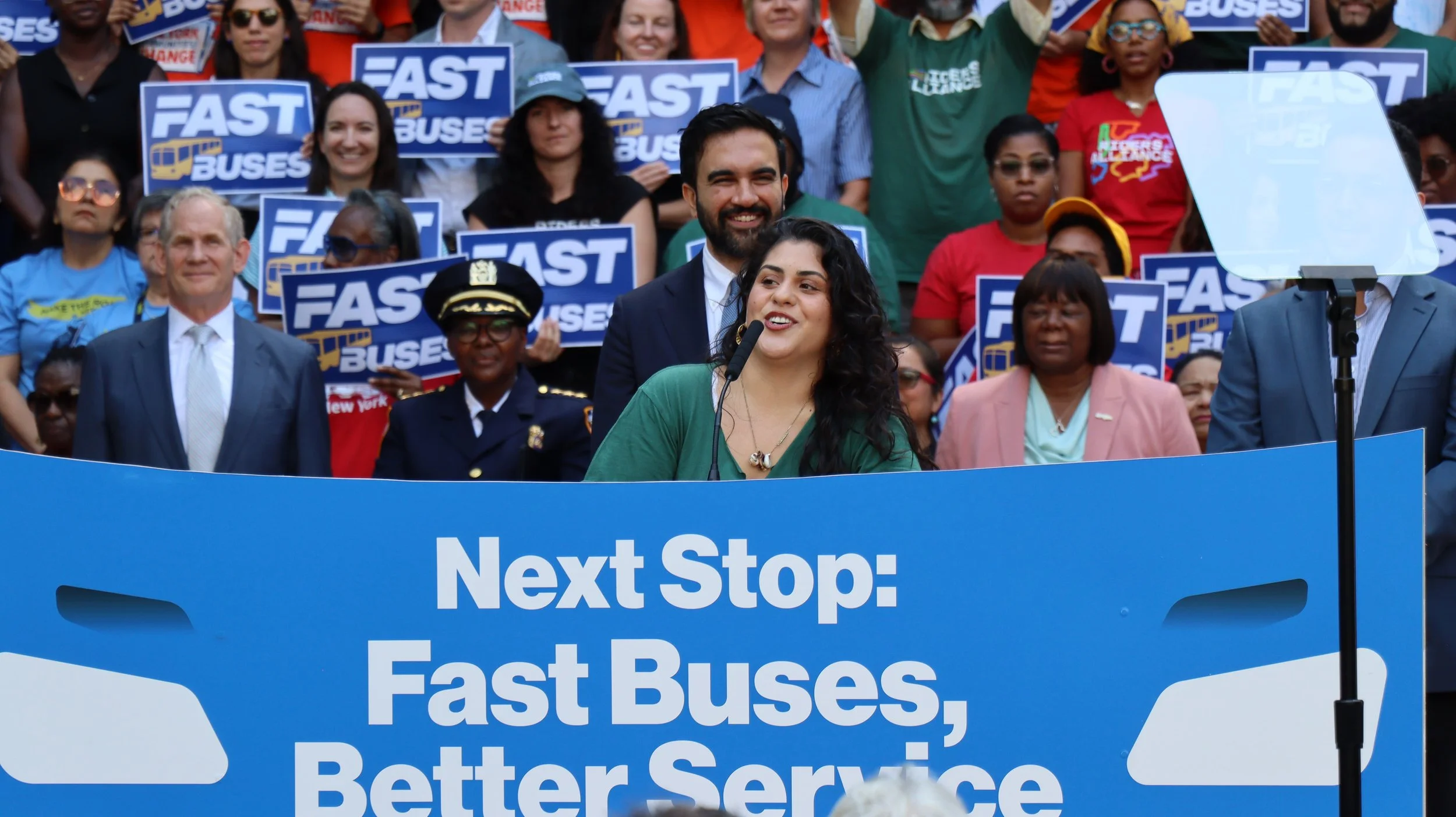
There are over 1 million daily bus riders in New York.
Together, we have the power to win Fast, free & fully-Funded bus service. Alone, we’re just stuck in traffic.
We’re building a rider-led movement to Fix the Bus—join us!
Fast, free, & fully-funded buses are the vehicle to a more just and sustainable city.
What we’re fighting for
New York City’s buses are literally the slowest in the country—avergaging just 8MPH—and they’ve held that title for far too long. After more than a decade of advocating for a comprehensive plan to address this, Riders Alliance launched a political action arm to support a Mayoral candidate who ran on a platform centering this very issue at the core of their campaign.
Now that New Yorkers have a Mayor who’s serious about doing right by riders—releasing a massive, citywide action plan to transform bus service—we’re mobilizing a movement of working-class bus riders to leverage the power of the 1,000,000+ who depend on our buses daily to demand the necessary policy, infrastructure, and resources to make every single bus route Fast, Free, and Fully-Funded.
Why it matters
New York City buses are the slowest in the nation. For many riders, this means spending far too much time waiting for the bus, commuting to work, taking their kids to school, and more. Spotty service also means that sometimes bus riders simply can’t get to where they’re going. This is especially true for bus riders who live outside more central or wealthy areas of the city, which lack subway access, and disproportionately experience long rides and unreliable commutes. Read the stories of 50 NYC bus riders in Bus Rider Blues.
Slow buses are not just a matter of convenience — they’re a matter of racial justice and transit equity. Bus riders are primarily from working-class communities of color. They have an average income of less than $30,000 a year, 55% are immigrants, and 40% of essential workers ride the bus. From the lack of sheltered waiting areas at bus stops (in comparison to comfortable waiting environments at commuter rail stations), to the antiquated bus routes that still follow old trolley paths and haven’t been updated for speedier, more efficient service, the legacy of racism in public transit is real. The result is stark inequity between local bus services used primarily by Black and brown city residents and other modes of transit, especially the rail services used primarily by white, 9-to-5 office workers shuttling in from the suburbs, to say nothing of highway users.
The fixes are not difficult. While not every part of the city is easily accessible by subway, buses can reach nearly every block, and busways can cost as little as a can of red paint. Faster and more reliable bus service would mean that no job, school, or doctor’s office would be out of reach. Riders in every borough and neighborhood deserve access to work, education, and healthcare - without the wait.
🚍
Resources

Much Better Buses: It’s About Time
Much Better Buses could be on their way to our streets, and it’s about time! Here’s how the incoming Mayoral administration can go beyond simple red paint and create a citywide network of gold-standard transit service to put time and money back into the hands of New Yorkers.

Better Buses for Flatbush Avenue: Participatory Research Report
We partnered with Pratt Center for Community Development to conduct a Participatory Action Research project in order to better understand the economic, social, health, and other community impacts of current bus service on Flatbush Avenue, potential improvements, and the costs of delaying those improvements.
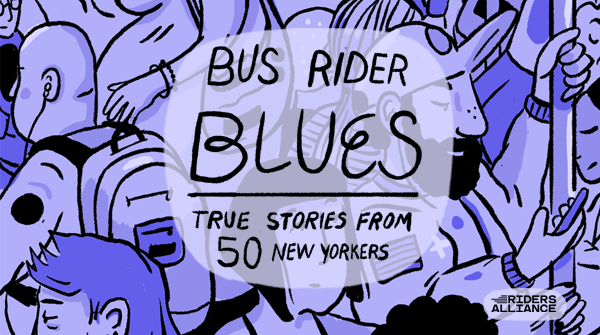
Bus Rider Blues
Real stories from 50 New Yorkers on what it’s like riding the slowest Buses in America, collected at bus stops across the city in 2021.

“As someone who uses a cane, I know firsthand how important it is to have reliable and accessible bus service. When the bus is delayed, the pain of waiting outside can be unbearable.”
— Khadedrah Spalding, Riders Alliance Member
Join us!
Get involved

Join our campaign for Better Buses to hold elected leaders accountable to their commitments to improve bus service for all New Yorkers.