
In January, as transit fares rise to $3, a new Mayor who was elected by an overwhelming majority of transit-dependent communities will be sworn in. And, with affordability continuing to be the top concern across the nation, the stakes for delivering more affordable public transit couldn’t be higher — particularly for the 1 in 5 New Yorkers who say they already struggle to pay the fare as is.
This moment will be our greatest opportunity in a generation to win for more affordable, reliable and accessible public transit. And in order to bring about the transformational change riders deserve, we must set bold, visionary goals and redefine success as more than a policy ideal for advocates to aspire to, but as tangible results that can be plainly seen on our streets and felt in our pockets.
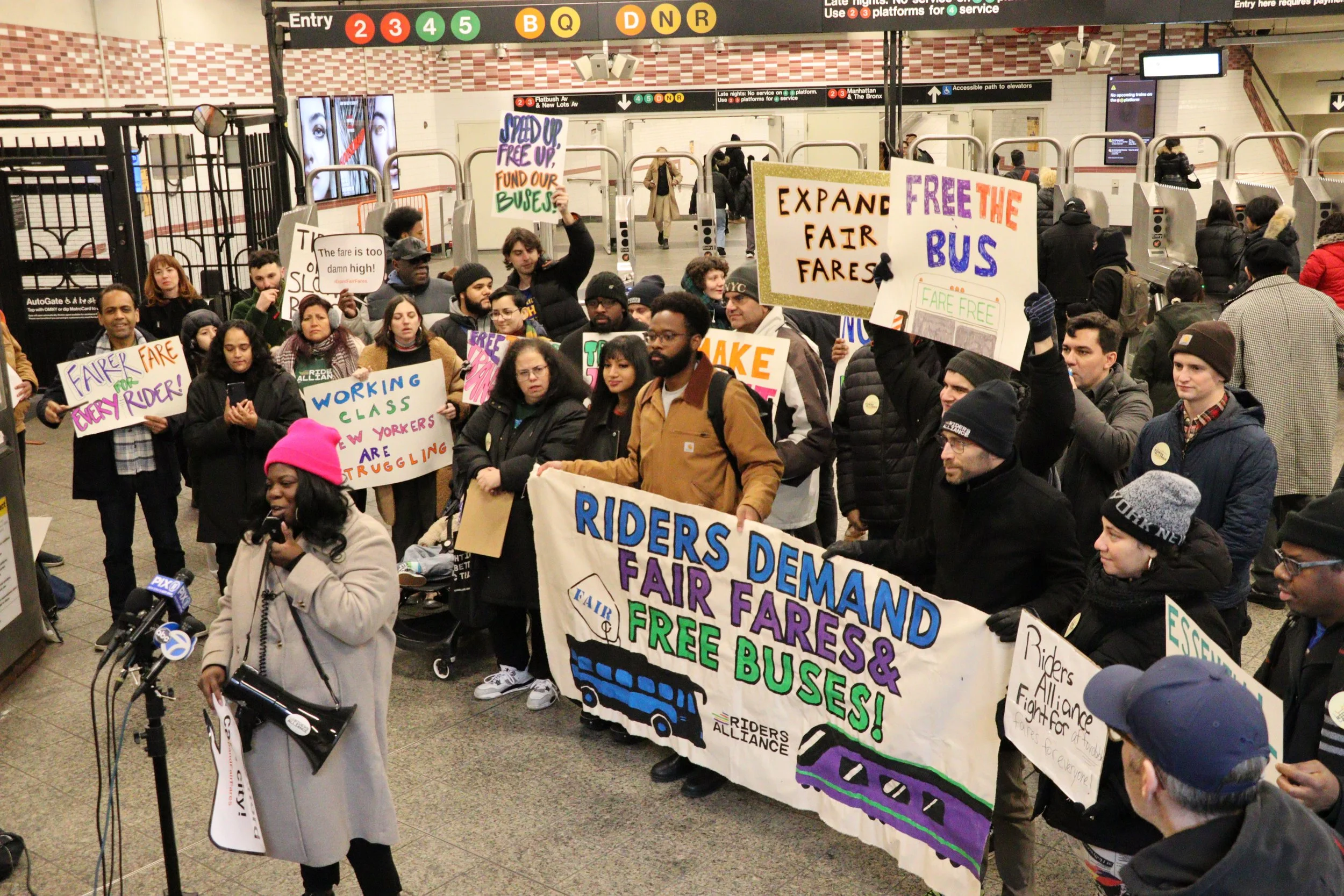
On Sunday, we launched our latest campaign to win a set of policies that will help bring about that shift for millions of riders.
Riders for Affordable Transit
Our core affordability demand for our next Mayor is to bring transit within greater reach of all New Yorkers by eliminating bus fares and expanding Fair Fares to bring free and half-priced transit to over 2 million working-class New Yorkers.
Here’s what that would look like:
Fare-free buses for every rider
Half-price subway fare for riders earning up to 300% of the Federal Poverty Level (up to $46,950 for individuals or $96,450 for households of 4)
Free subways and buses for riders earning up to 150% of the Federal Poverty Level (up to $23,475 for individuals or $48,225 for households of 4)
Expanding Fair Fares
Our proposed Fair Fares expansion would make nearly 30% of New Yorkers (over 2 million riders!) eligible for half-price or free transit fare. In some Council districts, up to 50% of residents would be newly eligible.
As we argue in our joint report with PCAC and CCS, expanding Fair Fares eligibility is well overdue and would save riders time as well as money. Compared to other cities with similar transit affordability programs, New York’s Fair Fares program lags behind with income limits that are much lower than what’s needed to offer relief to low and middle-income riders.
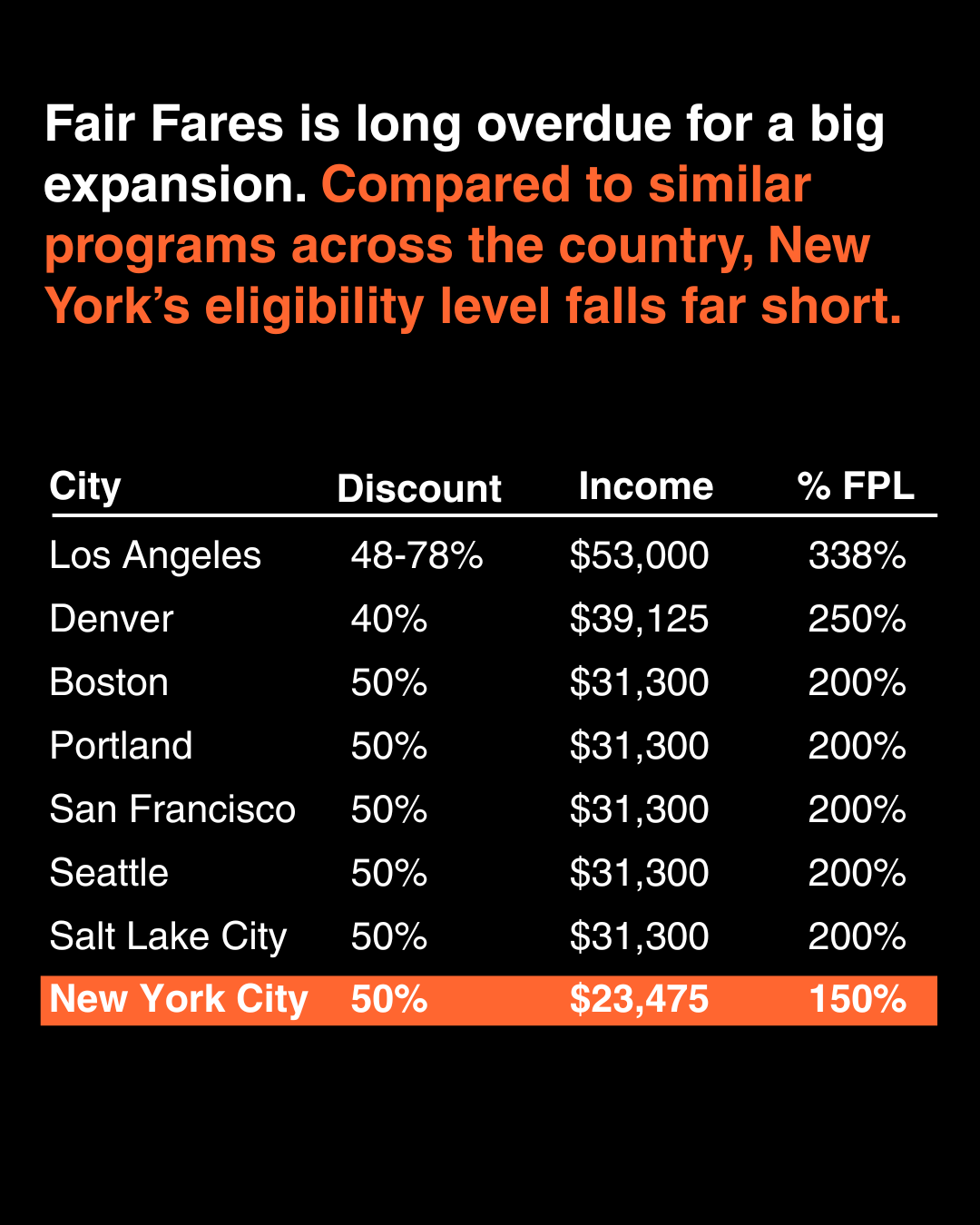
For example, transit agencies in DC, Austin, Denver, Boston, San Francisco, and Seattle all use a 200% income threshold to determine eligibility for reduced-fare programs. In LA, it’s at 300%, double New York’s and the minimum we believe is suitable to meet the needs of one of America’s least affordable cities.
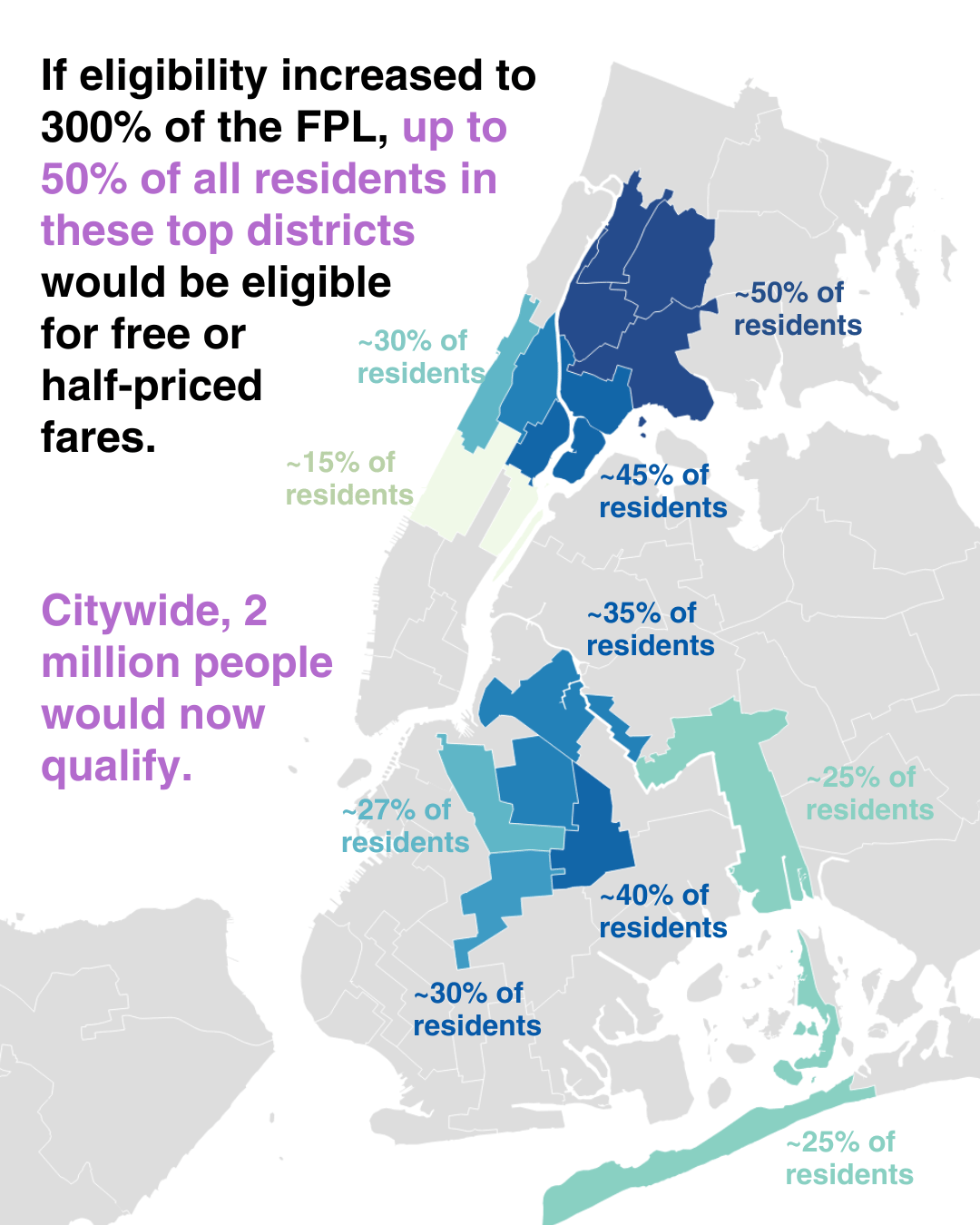
Thanks to analysis from PCAC, we can identify the top council districts with the most newly eligible riders if Fair Fares eligibility were expanded to 300%.
In addition to expanding the Fair Fares program, we also urge City Hall to eliminate unnecessary bureaucratic obstacles and automate enrollment to make it easy for every eligible rider to benefit.
Free buses
Free buses will eliminate transit fares as a barrier for millions of riders. As we’ve mentioned, 1 in 5 riders can’t afford the fare, including more than one-third of low-income working mothers and nearly 2 in 5 Latino riders. But to further demonstrate how free buses would serve as a relatively instant, targeted solution to uplift New Yorkers who need it most, we can look towards the top district for newly eligible riders: Council District 16 in the Bronx, which includes the Highbridge and Concourse neighborhoods where nearly half (47%) of residents would qualify for free or reduced fares, 76% don’t own a vehicle, and 66% primarily commute via public transit.
And, citywide, with bus riders earning 20% less on average than subway riders, it’s not a surprise that, as is, only about half of bus riders are paying the fare. This isn’t just indicative of an ongoing affordability crisis that threatens the sustainability of working, living, and raising a family in New York, but a fiscal crisis that threatens the sustainability of MTA’s revenue model that sources roughly 30% of its operating budget from the farebox.
And while some may regard these as compounding issues that must be solved through rigid fare enforcement, we know from experience that pouring resources into fare enforcement efforts does not come close to making up for revenues lost to fare evasion, but rather contributes to unreliable service (as MTA/NYPD Eagle Teams routinely halt buses mid-route to individually confirm payments) and risk criminalizing the working poor, who in many neighborhoods are representative of the riding public.
Instead, by offering universal access to free buses and delivering sustainable funding for transit operations sourced from city and state budgets, we can expand access to opportunity for millions while allowing MTA to focus its finite resources on providing world-class transit service to a growing ridership.
What’s next?
In 2026, we’re entering a period of unprecedented opportunity to win monumental policy whose impacts will be seen and felt by millions of riders and define a generational shift in how we understand, utilize, and support our transit system.
But getting there, as with everything else we’ve accomplished together as organized riders, means we’ll have to fight for it. At our Riders for Affordable Transit launch rally last Sunday, we gathered our voices to kick off the next phase of our rider-powered movement to integrate this policy proposal into the lived experience of millions of New Yorkers. Now’s the time for us to continue building the power necessary to make affordable transit a top priority for City Hall to consider in its budget negotiations and for free buses and an expanded Fair Fares to be echoed as the clear solution by riders, advocates, and elected leaders.