Welcome to Transit TLDR, where we watch the MTA Board meetings so you don’t have to! The board didn’t meet in August, so there was a lot to cover in September. If you have 3 hours, you can definitely go watch the whole thing yourself, but if not, here’s the 3 minute recap.
Here are the highlights riders should know:
Janno’s Updates
CEO and Board Chair Janno Lieber kicked off the meeting with updates on:
Ridership records
On September 23, subway ridership hit a new post-COVID high with 4.6 million rides in a single day. On commuter rail, both the Metro-North and LIRR surpassed their pre-COVID ridership baselines on multiple days in August.Mr. Lieber goes to Washington
In September, Janno went to DC for a Safety & Security Summit with transit leaders from across the country. Cyber security was a hot button issue, with the MTA battling off “a huge volume” of cyber incursions as of late. Janno said the federal government must take more responsibility for cyber security at the MTA, calling it a “global security issue.”Sean Duffy: Transit Champ or Transit Chump?
Could our USDOT Secretary finally be coming around on transit? Janno claims (though I can’t find a video of this anywhere…) that at the summit, Sean Duffy, United States Transportation Secretary, said:
“Transit is the best way for the federal government to deal with mobility issues in cities. Federal transit investment should be a bipartisan issue.”
Couldn’t agree more, Duff! Here are a few things you should probably address though if you’re serious about this change of heart:
When you said there was “no way in hell” you’d put your daughter on the subway
When you said you wanted to eliminate the mass transit element of the Federal Highway Trust, which provides 85% of all federal transit and passenger rail funding
When you delayed and underspent the All Stations Accessibility Program (ASAP) for two years, a grant that was already fully funded for accessibility upgrades in New York City
When you illegally froze federal dollars for the Second Avenue Subway or tried to block funding for the Gateway Tunnel Project
When you cut federal counterterrorism funding for New York’s transit
But enough about Sean Duffy, let’s get back to the MTA. Janno shared some MTA accomplishments since the last meeting in July…
Awarded a contract for a resiliency project for the Metro-North on the Hudson Line to protect from extreme weather events
Wrapped up their summer of public outreach about the IBX (here’s what they handed out at the community pop-ups, ICYMI)
Completed accessibility projects in 5 subway stations:
Prospect Park (B, Q, S)
149 St-Hostos (2, 4, 5)
Jamaica-179 St (F)
Kings Hwy (F)
Crown Hts-Utica Av (3, 4)
Purchased 650 new Compressed Natural Gas (CNG) buses
With the City, announced a plan to research thermal energy as a way to cool subway stations
Had first quarterly meeting with the City about implementation of the Next Stop: Fast Buses plan
Celebrated the reopening of Tracks Bar and Grill in Penn Station, where MTA bigwigs and local electeds enjoyed a pint from the freshly-blessed taps
Trump’s Terrible Tariffs Trouble Transit
Jessie Lazarus, Chief of the MTA Rolling Stock Program, followed Janno’s presentation with an update on the unpredictable world of tariffs and the impact they’re likely to have on rolling stock.
The Buy America Act requires 70% of the costs of federally funded rolling stock projects to be produced in the United States, and final assembly must also happen in the United States.
However, you can’t get everything in the US. Specialized parts like wheels and axles, motors and compressors, and modern signals must be imported internationally.
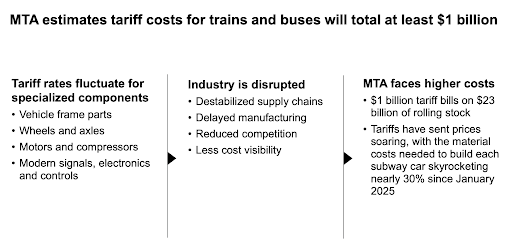
Screenshot from Jessie Lazarus’ presentation to the MTA Board on September 30, 2026 about the impact of tariffs on rolling stock procurement.
The MTA estimates that the Trump administration’s tariffs will add an extra billion dollars to the cost of new buses and trains. To put that amount in perspective, $1 billion could buy nearly 1,000 new buses or almost 300 new subway cars.
The day of the board meeting, Governor Hochul sent a letter to the US Commerce Secretary Howard Lutnick demanding an exemption for the MTA from any tariffs on materials needed for rolling stock manufactured under Buy America compliant contracts. Board members asked what they can do to help advocate for the exemption, Janno said he’d keep them posted…
… and we’ll keep you posted on all things NYC transit!
Make sure you’re on our email list so you don’t miss an update. Until next month’s meeting! 👋